

Table of Contents[Hide][Show]
- First, figure out what kind of shade you actually have
- Why plants die under trees (it’s usually not the shade)
- Hostas
- Astilbe
- Heuchera (Coral Bells)
- Ferns
- Brunnera
- Bleeding Heart
- Lungwort (Pulmonaria)
- Hellebores
- Solomon’s Seal
- Lamium (Dead Nettle)
- Foamflower (Tiarella)
- Japanese Forest Grass (Hakonechloa)
- Epimedium (Barrenwort)
- Toad Lily (Tricyrtis)
- 11 more shade plants worth knowing
- The cheapest way to fill a shade bed
- Shade plants deer won’t touch
- Three mistakes people make in shade beds
- Shade Perennial FAQ
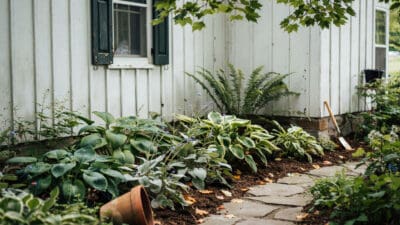
There’s a strip along the north side of my house that I killed things in for three years straight.
Petunias, impatiens, a hydrangea I felt genuinely guilty about. I’d buy something, plant it, water it faithfully, and watch it go pale and leggy and then just — stop. I finally decided the spot was cursed and put a bench there instead.
It wasn’t cursed. I was buying the wrong plants, and every shade plant list I read was written by somebody with dappled shade. You know the kind — pretty filtered light coming through a couple of birches, a little morning sun. That’s not shade. That’s a nice place to sit.
Real shade is the north side of a house. It’s the packed dry dirt under a silver maple where the roots have already taken everything. It’s the side yard between you and your neighbor’s garage that gets about forty minutes of sun in July and none at all in October.
So this list is for that. These are shade perennials and shade plants that survive actual shade — most of them cheap, most of them low maintenance, and a good handful of them the kind you can split and spread around for free once they get going.
I’m in zone 5 here in Western New York, and everything on this list has either lived in my yard or in my mom’s.
Let’s start with the part that changes everything.
First, figure out what kind of shade you actually have
Before you buy a single plant, go stand in the spot at 10am, 1pm, and 4pm on a sunny day. That’s it — that’s the whole test. Here’s what you’re sorting it into:
Part shade — 3 to 6 hours of sun, usually morning. Easiest kind. Most of this list will be thrilled here.
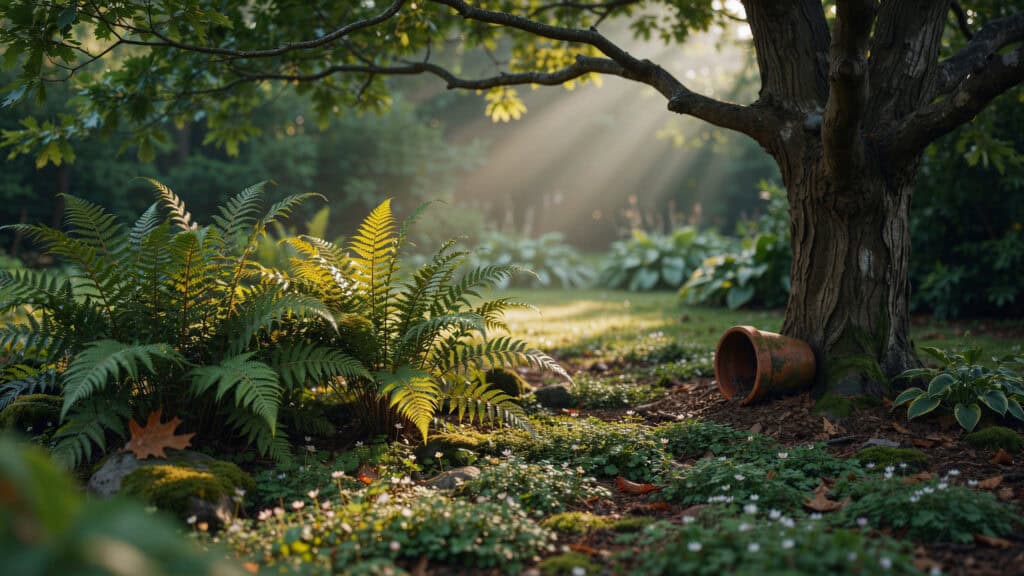
Dappled shade — light filtering down through a tree canopy all day. Think a mature oak with high branches. Also easy, and the closest thing to a woodland floor.
Full shade — under 3 hours of direct sun, or none at all. North sides of buildings, deep under evergreens, narrow spots between houses. Fewer options, but plenty of good ones.
Dry shade — full shade plus competing tree roots sucking up every drop of water. Under maples, under spruces, right up against a foundation. This is the hard one. This is the spot everybody’s actually asking about.
If you’ve got that last one, skip ahead and read the next section before you buy anything. It’ll save you money.
Why plants die under trees (it’s usually not the shade)
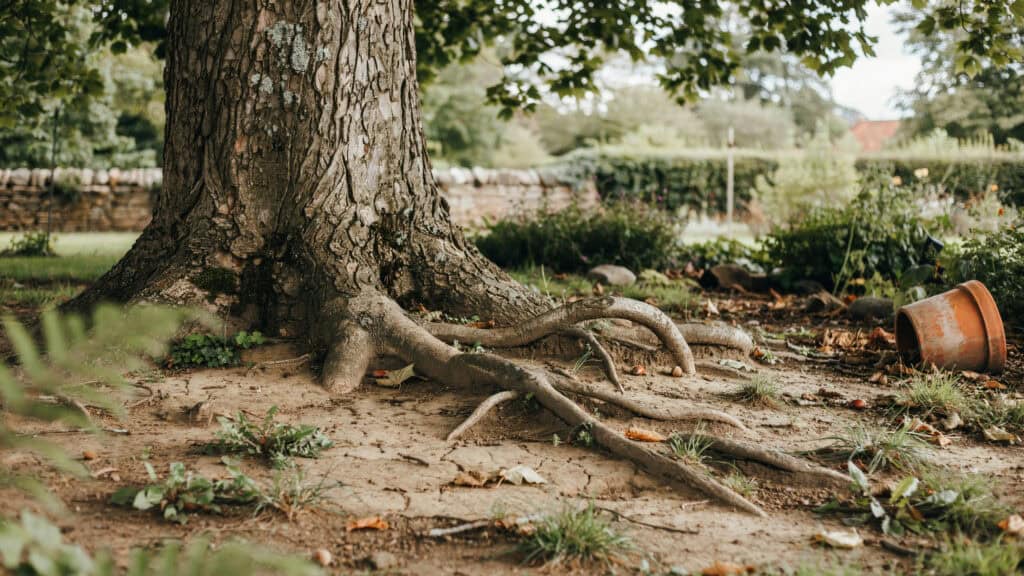
Here’s the thing nobody tells you: most plants that fail under a big tree didn’t die from lack of light. They died of thirst.
A mature maple drinks an enormous amount of water, and its feeder roots sit in the top few inches of soil — exactly where your new perennial is trying to establish.
You water, the tree takes it. You water again, the tree takes that too. Your plant is essentially trying to grow in a sponge that’s already been wrung out.
Norway maples are the worst about it. Silver maples and beeches are close behind. If that’s what you’re working under, you’re not looking for shade plants — you’re looking for dry shade plants, which is a much shorter and more specific list.
Two more things that matter under trees:
Don’t build up soil over the roots. It feels like the obvious fix — dump six inches of good topsoil and plant into that. But burying tree roots suffocates them, and you can kill a mature tree that way over a few years. Add an inch or two of compost at most.
Plant small, and plant in the gaps. Don’t try to dig a wide hole. Find pockets between the big roots, use quart-sized plants instead of gallons, and let them fill in. A small plant that establishes beats a big one that never does.
Alright. The plants.
Hostas
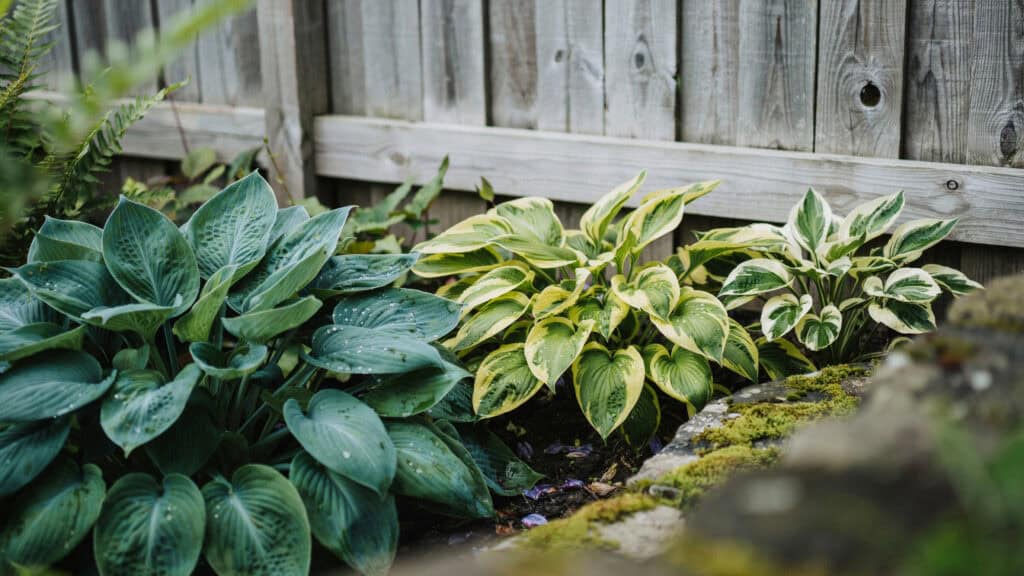
The one everybody starts with, and honestly for good reason. Hostas will grow in places you’d swear nothing would; they come in about four hundred varieties from teacup-sized to nearly four feet across, and a single plant will give you three or four more within a few years.
The blue-leaved varieties want the deepest shade — that waxy blue coating burns off in sun. Gold and chartreuse types can take a little more light. Variegated ones sit in the middle.
One honest warning: deer eat hostas like it’s their job. If you’ve got deer pressure, either fence them, spray them, or plant them close to the house and use something else out at the edges.
Best for: Filling space fast, and getting free plants by division Light: Part shade to full shade Zones: 3–9 Spreads? Clumps get bigger every year — divide in spring
READ: Hosta Landscaping: 15 Ways to Design With Hosta
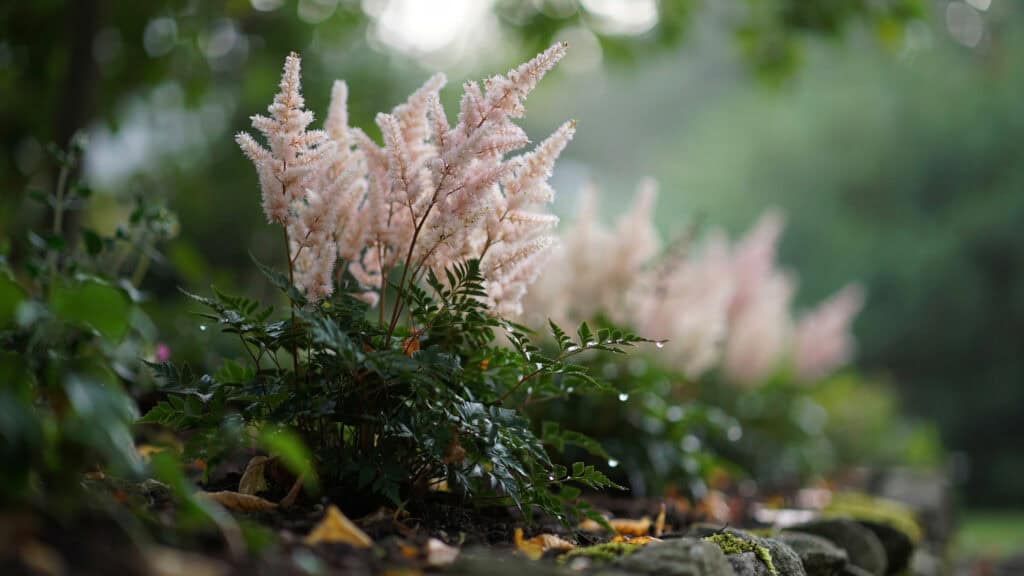
Astilbe
If you want actual flowers in shade and not just foliage, astilbe is where to start. It sends up feathery plumes in early to midsummer in white, pink, coral, and a red that’s almost burgundy, and the fern-like leaves look good even when it’s not blooming.
The catch is water. Astilbe wants consistently moist soil and it will tell you loudly when it doesn’t get it — the leaf edges go crispy brown and it sulks for the rest of the season. Which means it’s a great choice for a low damp corner and a bad choice under a maple.
Best for: Real color in a shady bed Light: Part shade to full shade Zones: 3–9 Spreads? Slowly, by clump. Divide every 3–4 years
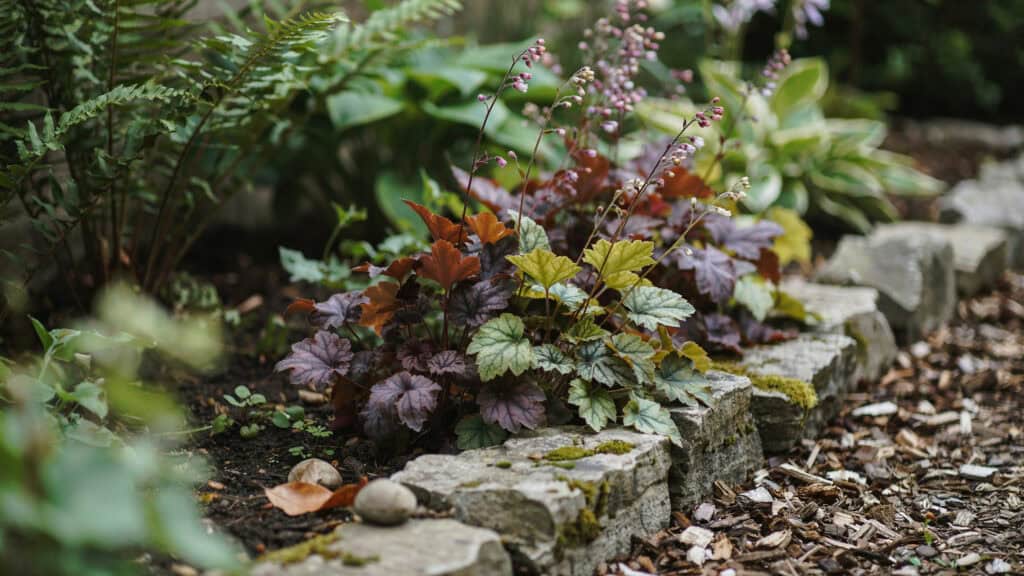
Heuchera (Coral Bells)
Coral bells are how you get color in a shade bed without depending on flowers at all. The foliage does the work — deep purple, lime green, caramel, silver, near-black — and most varieties hold their leaves right through winter here.
They do send up thin wands of tiny flowers that hummingbirds like, but you’re growing them for the leaves.
They’re not long-lived compared to some things on this list. Heuchera tends to push itself up out of the ground over a few years, a thing called frost heaving, and the crown gets woody. Every third spring, dig it up, cut the woody part off, and replant the good crown deeper. It’ll act brand new.
Best for: Year-round color, edging, containers Light: Part shade — full shade works but colors get muted Zones: 4–9 Spreads? No. Stays put, gets wider slowly
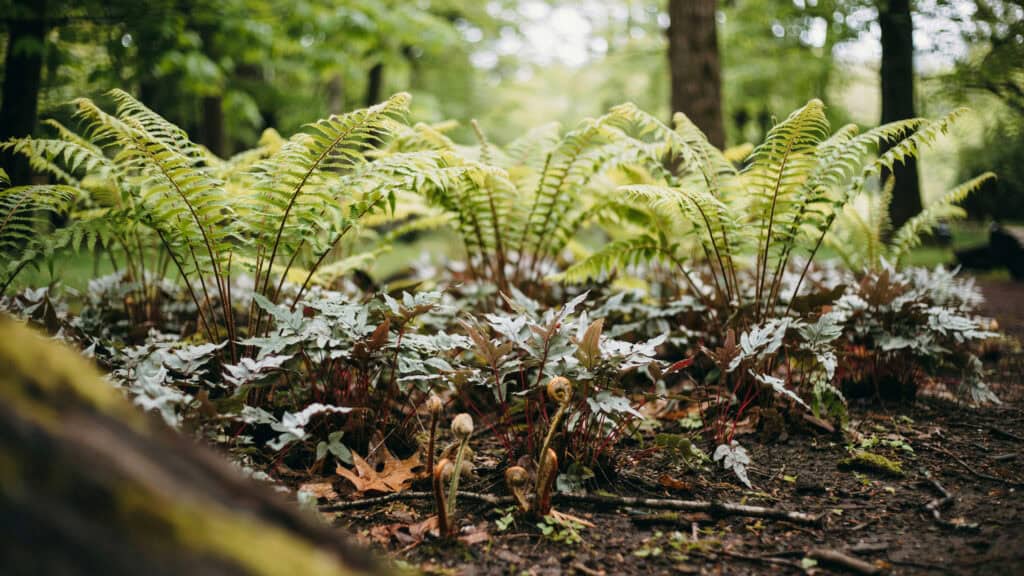
Ferns
Ferns are the plant I’d hand somebody who’s never gardened in shade before, because they’re nearly impossible to get wrong. Three worth knowing:
Ostrich fern — big, tall, aggressive. It’ll hit four feet and it spreads by underground runners, which is either exactly what you want for a big bare area or a problem in a tidy bed. These are also the ones that give you fiddleheads in spring.
Japanese painted fern — silver and burgundy, about eighteen inches, well-behaved. The prettiest of the three by a mile.
Autumn fern — coppery new growth that ages to green, mostly evergreen through winter.
Deer generally leave all of them alone, which makes ferns a good backbone for the outer edges of a shade bed.
Best for: Texture, filling large areas, deer-heavy yards Light: Part shade to full shade Zones: 3–8 depending on type Spreads? Ostrich fern yes, aggressively. Others clump.
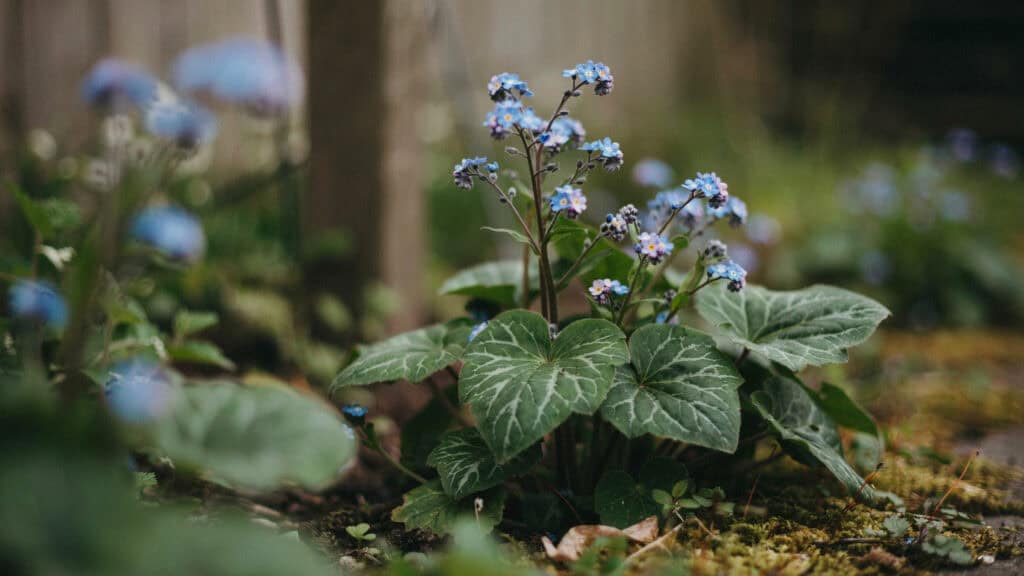
Brunnera
Brunnera is the one that makes people stop and ask what it is. The variety ‘Jack Frost’ has heart-shaped leaves that are almost entirely silver with green veining running through them, and in spring it throws up sprays of tiny blue flowers that look exactly like forget-me-nots.
It’s one of the few plants that genuinely brightens a dark corner — that silver picks up whatever little light there is and reflects it back.
It wants decent moisture and it does not want afternoon sun. Give it either and the leaves scorch at the edges.
Best for: Lighting up a dark corner Light: Part shade to full shade Zones: 3–8 Spreads? Slowly by clump
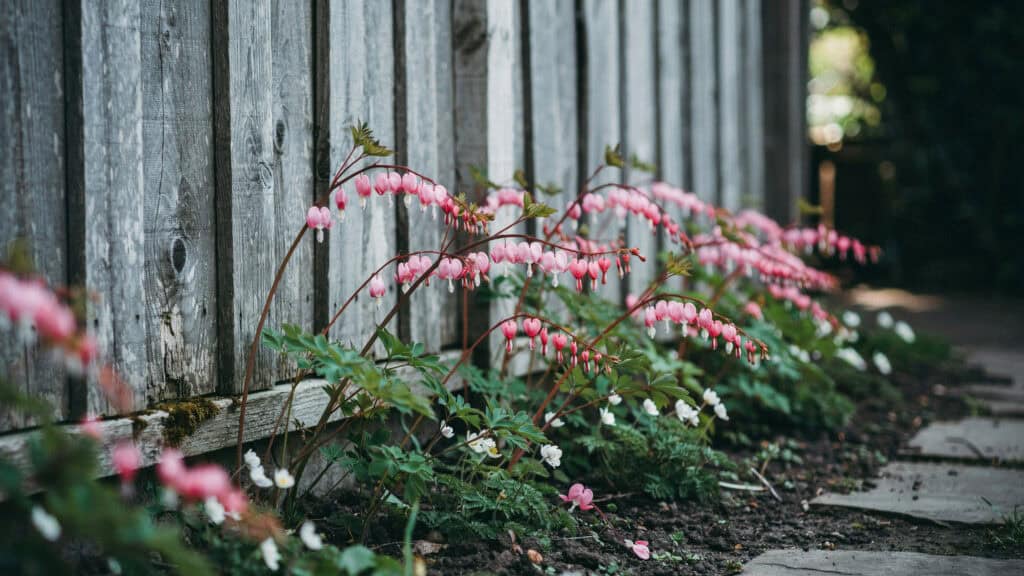
Bleeding Heart
Old-fashioned, and I mean that as a compliment. Arching stems hung with those little pink-and-white heart-shaped flowers, blooming in mid-spring right when you need something to be happening.
Here’s what to know so you don’t panic: bleeding heart goes dormant in midsummer. The whole plant yellows and disappears by July, and that’s normal — it’s not dying, it’s done. Plant a hosta or a fern next to it to fill the hole it leaves behind.
The fringed varieties are less dramatic but bloom on and off all season and don’t go dormant.
Best for: Spring color, nostalgic cottage look Light: Part shade to full shade Zones: 3–9 Spreads? Clump. Self-seeds a little.
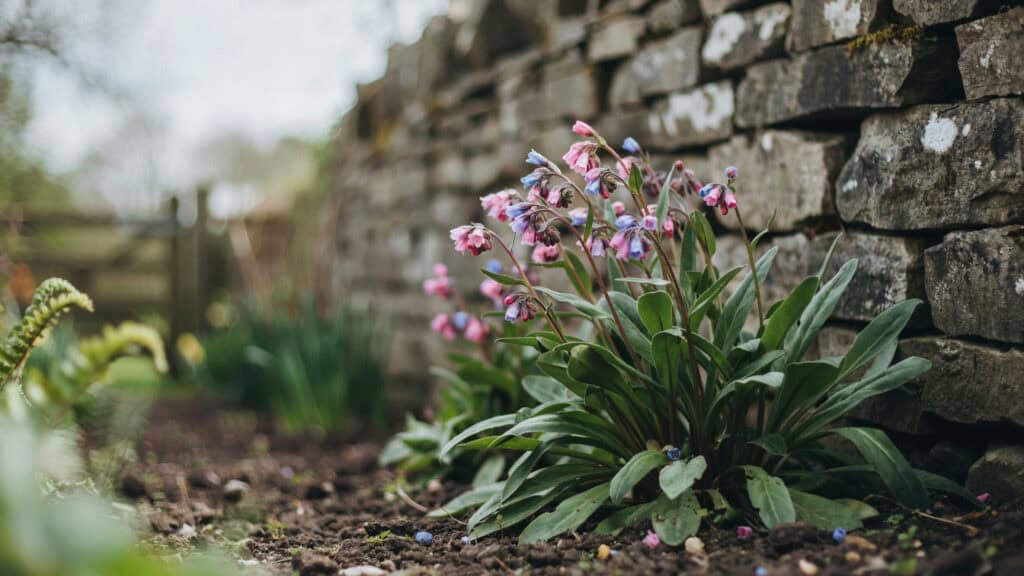
Lungwort (Pulmonaria)
Awful name, wonderful plant. Lungwort blooms very early — often the first thing flowering in my shade bed — and the flowers open pink and turn blue, so you get both colors on the same plant at once.
The leaves are long and spotted with silver, and they look good all season after the flowers finish. It handles more dryness than most things here, and deer and rabbits both leave it alone.
Best for: Very early color, deer resistance Light: Part shade to full shade Zones: 3–8 Spreads? Slowly, by clump
Hellebores
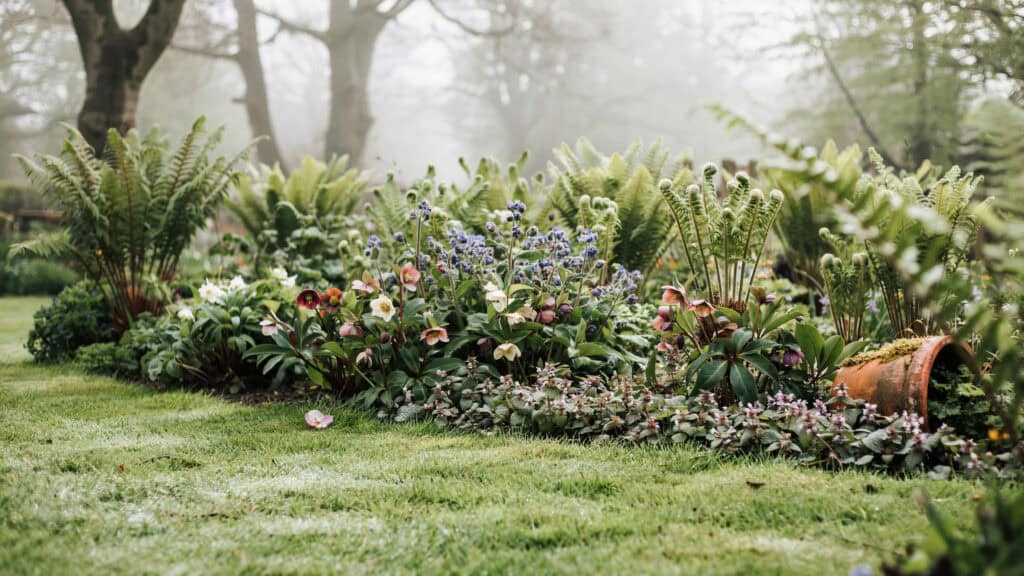
Hellebores bloom in February. Sometimes January. In Western New York, with snow still on the ground, this plant puts out big nodding cup-shaped flowers in white, plum, green, and speckled pink, and it holds them for weeks.
They’re evergreen, deer completely ignore them, and once established they’re tough as anything. They’re not cheap — expect to pay more per plant than most things on this list — but a hellebore will outlive you. Buy one a year and let the collection build.
Cut last year’s tired leaves off in late winter so you can actually see the flowers.
Best for: Late-winter bloom when nothing else is happening Light: Part shade to full shade Zones: 4–9 Spreads? Very slowly. Self-seeds around the parent plant.
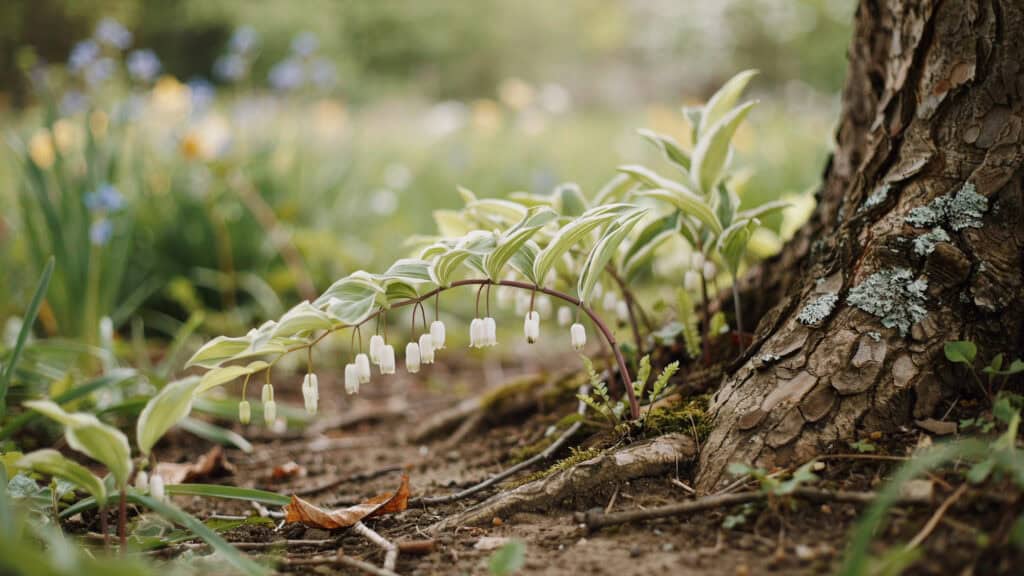
Solomon’s Seal
This is a dry shade plant. Arching stems about two to three feet tall with neat parallel leaves and small white bells hanging underneath in spring, then blue-black berries later. The variegated version has white-edged leaves and is worth the extra couple of dollars.
What makes it valuable is that it spreads by rhizome through dry root-filled soil where almost nothing else will establish. Under a maple, this is one of your best bets.
The foliage turns clear yellow in fall, which is a nice bonus in a bed that’s mostly green.
Best for: Dry shade under trees Light: Part shade to full shade Zones: 3–8 Spreads? Yes, steadily by rhizome. Easy to divide and move.
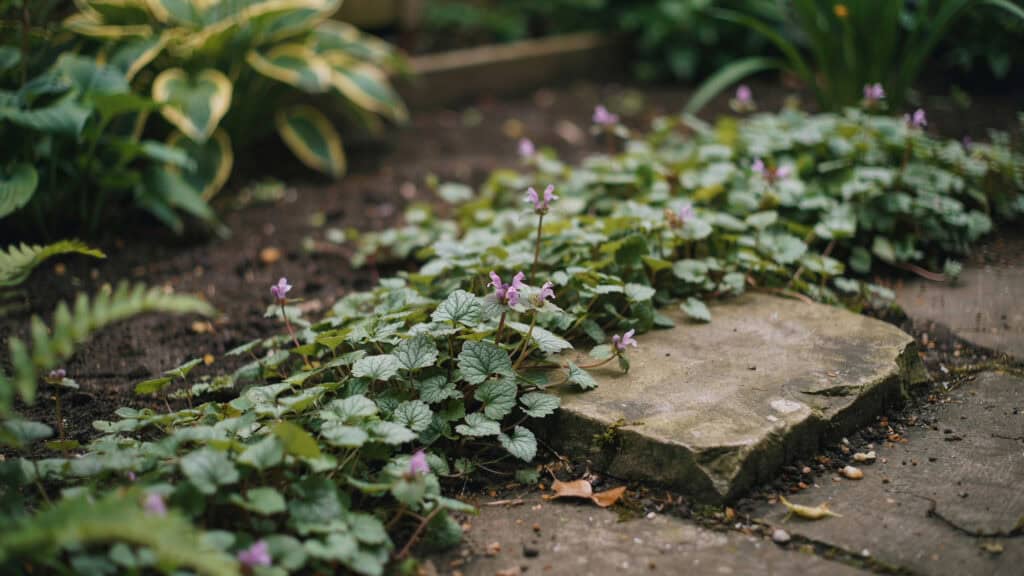
Lamium (Dead Nettle)
The cheapest way to cover ground in shade. Lamium runs along the surface, roots as it goes, and fills in bare dirt fast — silver-marked leaves with pink or white flowers in late spring.
Because it roots at the nodes, you can pull up a rooted piece, stick it somewhere else, water it twice, and have a new plant. One flat from the garden center turns into a whole bed in two seasons if you keep moving pieces around.
It can get away from you in a small tidy bed. In a big rough area under trees, that’s the entire point.
Best for: Free groundcover, filling bare dirt Light: Part shade to full shade Zones: 3–8 Spreads? Yes, quickly. Easy to pull back.
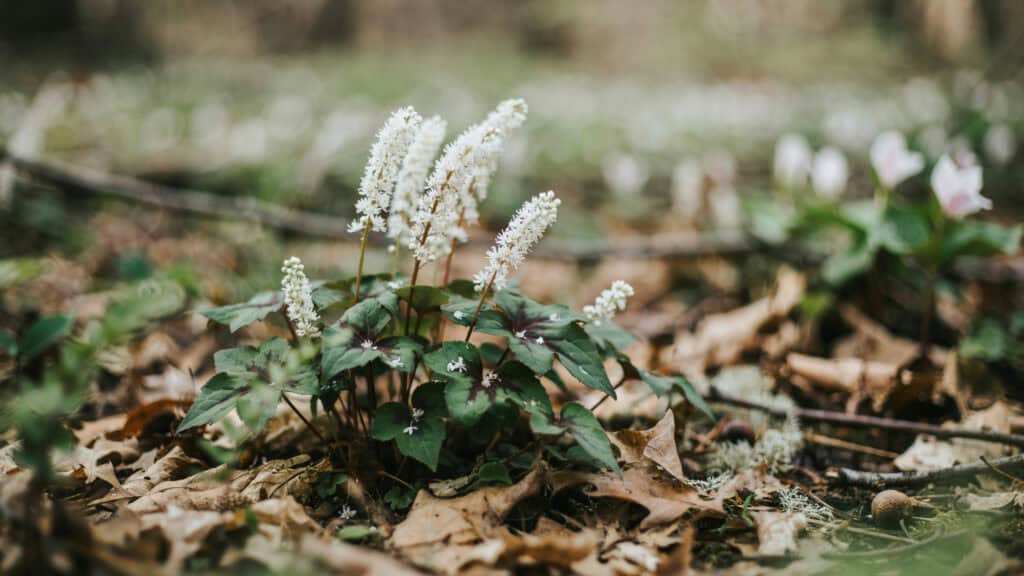
Foamflower (Tiarella)
A native woodland plant, which means it’s already adapted to exactly the conditions you’re trying to plant into. Frothy white or pale pink bottlebrush flowers in spring, and deeply cut maple-shaped leaves that often get a dark burgundy stripe down the veins.
It spreads politely — enough to make a nice colony over a few years, not enough to be a problem. Pollinators like it. It’s a good one to plant in a drift of five or seven rather than as a single specimen.
Best for: Native woodland planting, spring bloom Light: Part shade to full shade Zones: 4–9 Spreads? Slowly by runners
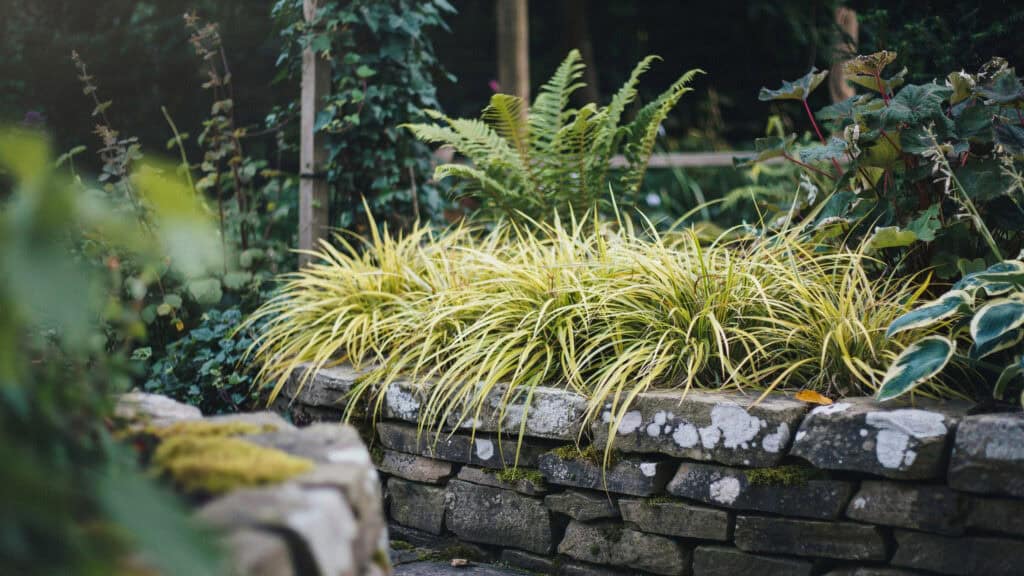
Japanese Forest Grass (Hakonechloa)
The texture plant. Everything else in a shade bed has broad rounded leaves, and this has fine arching blades that cascade like water over the edge of a bed or a wall. The gold variety ‘Aureola’ is the one you usually see and it glows in low light.
It’s slow. Genuinely slow — expect three years before it looks like the photo. Buy the biggest one you can afford and be patient with it, because there’s nothing else that does what it does.
Best for: Texture contrast, edges and slopes Light: Part shade to full shade Zones: 5–9 Spreads? Very slowly by clump
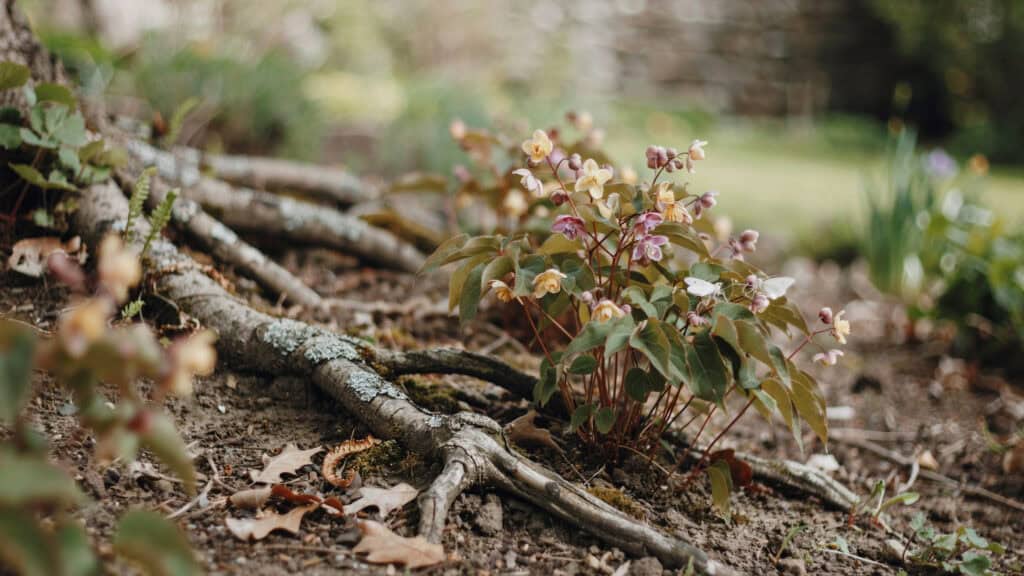
Epimedium (Barrenwort)
The other true dry shade plant, and almost nobody grows it.
Epimedium has wiry stems, heart-shaped leaves that come out bronze-tinted in spring, and small delicate flowers in yellow, white, pink, or dusty rose that look like little airborne columbines. It’s semi-evergreen and deer won’t touch it.
But the reason it’s on this list is that it thrives in dry shade under mature trees — the exact spot that defeats everything else. Once it’s established, it just quietly holds ground and asks for nothing.
It’s slow to start, so give it two seasons and don’t judge it in year one. Shear the old foliage in late winter before the flowers come.
Best for: Dry shade under trees. The hardest spot in the yard. Light: Part shade to full shade Zones: 4–8 Spreads? Slowly by rhizome. Worth the wait.
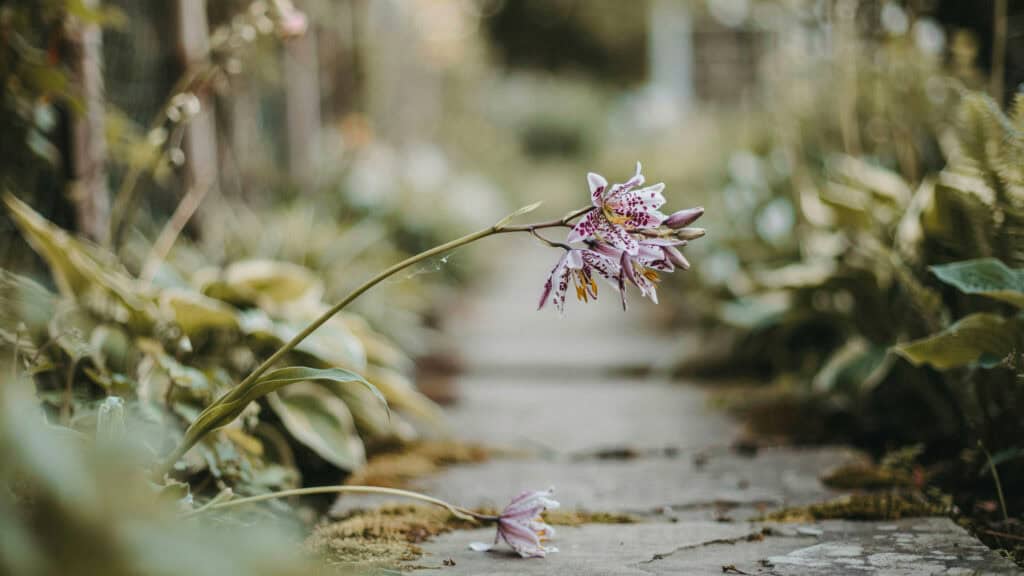
Toad Lily (Tricyrtis)
Toad lily blooms in September, when the rest of the shade garden has been coasting since June. The flowers are small and heavily speckled — orchid-like, purple and white — and you have to get close to appreciate them, which is why you plant this one along a path rather than at the back.
Wants moisture. Not a dry shade plant. But for extending your shade bed’s season by two months, there’s nothing better.
Best for: Late-season bloom Light: Part shade to full shade Zones: 4–8 Spreads? Slowly by rhizome
11 more shade plants worth knowing
Shorter notes on these, but they all earn their spot:
15. Bergenia (Pigsqueak) — thick glossy leaves that turn burgundy in cold weather, pink flowers in early spring. Zones 3–8. Tough as a boot.
16. Ajuga (Bugleweed) — low glossy groundcover with blue flower spikes in spring. Zones 3–9. Spreads fast — keep it away from lawn edges.
17. Sweet Woodruff — whorled green leaves, tiny white flowers, smells like fresh hay when cut. Zones 4–8. Excellent under shrubs.
18. Wild Ginger — native, glossy heart-shaped leaves forming a low mat. Zones 4–8. Handles dry shade better than most.
19. Jacob’s Ladder — ladder-like leaflets, blue spring flowers. Zones 3–8. The variegated form is beautiful.
20. Bugbane (Actaea) — tall, four to six feet, with white bottlebrush spires in late summer and often dark purple foliage. Zones 3–8. Use it at the back.
21. Virginia Bluebells — native spring ephemeral. Pink buds opening to true blue, then the whole plant vanishes by June. Zones 3–8. Plant with ferns to cover the gap.
22. Corydalis lutea — ferny foliage, yellow flowers from spring to frost. Zones 5–8. Seeds itself into stone walls and path cracks, charmingly.
23. Lily of the Valley — intensely fragrant white bells, spreads through dry shade with no help at all. Zones 3–8. Two warnings: it’s aggressive, and every part of it is toxic if eaten — keep it away from where children or pets graze.
24. Pachysandra — the classic evergreen shade groundcover. Zones 4–8. Reliable, but check whether it’s flagged as invasive where you are before planting a large area.
25. Vinca minor (Periwinkle) — trailing evergreen with blue flowers. Zones 4–9. Same caution as pachysandra — wonderful on a shady slope you can’t mow, a problem next to a woodlot.
The cheapest way to fill a shade bed
Shade beds look expensive because you need a lot of plants to make them read as intentional. Here’s how I’ve filled mine for almost nothing:
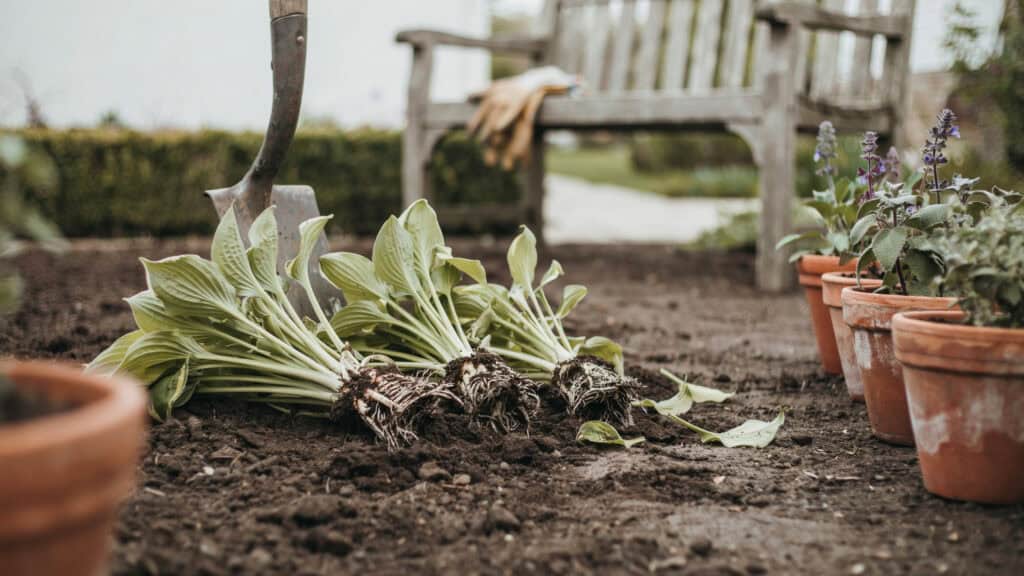
Divide what you already have. Hostas, astilbe, ferns, Solomon’s seal, brunnera — all of them split. One hosta becomes four in about ten minutes with a spade. Do it in early spring as the shoots come up, water well, done. This alone is most of my shade bed.
Ask around. Anybody with an established shade garden has hostas they’re sick of. Post in a local gardening group in April and offer to dig them yourself. I’ve never once been turned down.
Buy the end-of-season rack. Late August and September, garden centers mark perennials down 50–75% because they don’t want to overwinter them. They look terrible. It does not matter — you’re buying roots, and fall is the best planting time anyway. This is where I get hellebores and heuchera I’d never pay full price for.
Start with groundcover, not specimens. A flat of lamium costs less than one gallon-sized shrub and covers ten times the area within two seasons.
Take the pieces. Lamium, ajuga, sweet woodruff, and vinca all root as they run. Every time you weed, you’re generating new plants — move them instead of composting them.
READ: The Best Cheap Shade Perennials
Shade plants deer won’t touch
If you’re out past the mowed lawn — and here in WNY most of us are — this is the list that matters. From everything above, the ones deer reliably skip:
- Hellebores
- Ferns (all types)
- Lungwort
- Epimedium
- Brunnera
- Bleeding heart
- Lamium
- Japanese forest grass
- Bugbane
- Sweet woodruff
And the ones deer will find, no matter where you put them: hostas, and to a lesser extent heuchera and astilbe. Plant those close to the house where there’s foot traffic, and use the list above for the outer edges.
Read: Deer Resistant Landscaping Ideas Your Yard (and Wallet) Will Love
Three mistakes people make in shade beds
1. Watering it like a sunny bed. Shade soil dries slower and stays cool, and overwatering rots crowns. The exception is dry shade under trees, which needs more water than you think during the first season while roots establish. Check the soil with a finger instead of guessing.
2. Planting right against the trunk. Give a mature tree at least a foot or two of clearance. That zone is the driest, the rootiest, and the worst place to try to establish anything. Start your bed further out and work in.
3. Expecting sun-level bloom. A shade bed is a foliage garden with flowers as punctuation. Once you stop fighting that and start planting for leaf shape, color, and texture — silver against burgundy, fine grass against broad hosta — the whole thing gets easier and honestly looks better.
Shade Perennial FAQ
What perennials grow in full shade? Hostas, ferns, astilbe, brunnera, lungwort, hellebores, foamflower, and Japanese forest grass all handle full shade — meaning under three hours of direct sun. Full shade with dry soil is a different problem; for that, use epimedium, Solomon’s seal, or wild ginger.
Will these grow under a maple tree? Some will. Maples create dry shade with heavy surface roots, which defeats moisture-lovers like astilbe and toad lily. Your best bets are epimedium, Solomon’s seal, wild ginger, lamium, and lily of the valley. Plant small, water through the first full season, and don’t pile soil over the roots.
When should I plant shade perennials? Early spring or early fall. Fall is better — the soil is still warm, the air is cool, and roots establish over the winter with almost no watering from you. It’s also when perennials go on clearance.
Do shade perennials come back every year? Yes, that’s what makes them perennials. Most on this list will come back for decades and get bigger each year. A few, like bleeding heart and Virginia bluebells, disappear in midsummer and return the following spring — that’s normal dormancy, not death.
How far apart should I space them? Groundcovers 8–12 inches, mid-sized perennials 18–24 inches, and large hostas or bugbane 3 feet. It’ll look sparse the first year. Resist the urge to cram — shade plants fill in slowly but they do fill in.
 Chocolate Zucchini Bread (And 5 More Loaves From the Same Batter)
Leave a Reply