


Table of Contents[Hide][Show]
Every January, my Pinterest feed fills up with savings challenges. Some promise $10,000 in a year. Others want you to stuff 100 envelopes. And if you’re living paycheck to paycheck, most of them look impossible before you even start.
Here’s the thing I’ve learned the hard way: the best savings challenge is the one you’ll actually finish.
My husband and I got out of debt while living on one income, back when our girls were babies and toddlers. It was NOT easy. We didn’t do it with one giant leap. We did it with small, boring, consistent wins, and savings challenges were a big part of that. (Here’s our story if you want the long version.)
So I rounded up 15 savings challenges for every budget. Some start with pocket change. Some are built for bigger goals. Every one has the real math, so you know exactly what you’ll end up with before you commit.
Grab a cup of coffee (homemade, of course), and let’s find the one that fits your paycheck.

What Is a Savings Challenge?
A savings challenge is a set plan that tells you exactly how much to save, and when. Instead of “I’ll save whatever is left over” (which, let’s be honest, is usually nothing), you follow a schedule. Week 1, save $1. Week 2, save $2. Check the box, watch the total grow.
That’s why money-saving challenges work so well for people who have struggled to save before. They take the guesswork out. You don’t have to decide every payday whether you can afford to save. The chart already decided for you.
Most savings challenges fall into a few types:
- Increasing challenges start small and add a little each week or paycheck, like the 52-week challenge.
- Flat challenges save the same amount every time, like $20 a week.
- Random challenges use envelopes or a chart you fill in any order.
- Spending challenges save money by not spending, like a no-spend month.
There’s no wrong type. Pick the one that matches how your money actually comes in.
How to Pick the Right Savings Challenge for Your Income
Before you print a single chart, sit down with your monthly budget. You need to know what’s left after bills, groceries, and gas. That number decides which challenge is realistic.
A few rules I go by:
- Match your pay schedule. Paid weekly? Pick a weekly challenge. Paid every two weeks? Go bi-weekly so every save lines up with a paycheck.
- Start smaller than you think. When I first tried a savings challenge, I aimed way too high and burned out. Hitting a small goal beats quitting a big one.
- Watch the end of the challenge. Increasing challenges get expensive at the end. Week 52 of the classic challenge asks for $52, right in late December.
Here’s every challenge in this post at a glance:
| Challenge | Total saved | Best for |
|---|---|---|
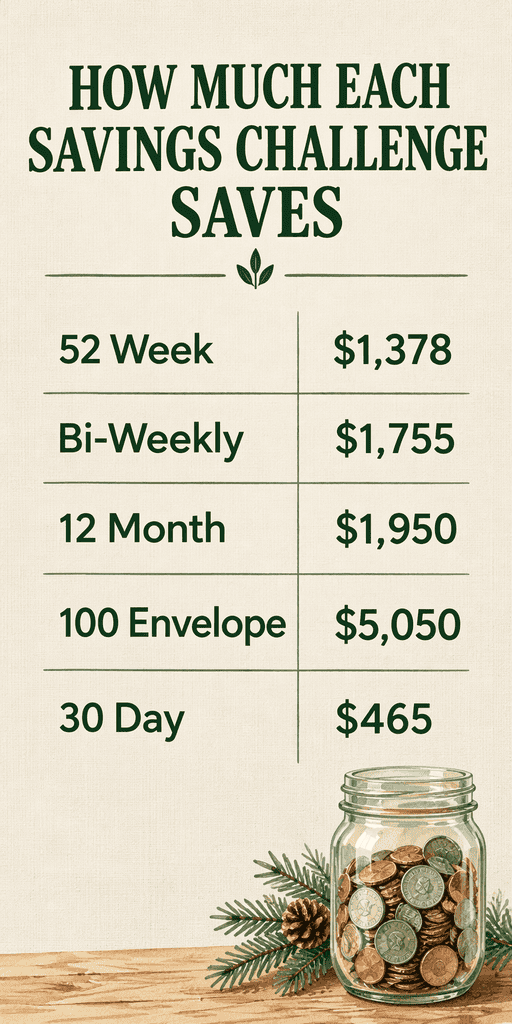
| 52 week money saving challenge | $1,378 | Weekly paychecks |
| Reverse 52 week challenge | $1,378 | Avoiding a December crunch |
| Half-size 52 week challenge | $689 | Low income budgets |
| Bi-weekly savings challenge | $1,755 | Paid every two weeks |
| 100 envelope savings challenge | $5,050 | Cash budgeters |
| 50 envelope savings challenge | $1,275 | Envelope beginners |
| 12 month savings challenge | $1,950 | Monthly pay or bills |
| 30 day savings challenge | $465 | A quick win |
| $1,000 in 3 months | $1,001 | Starter emergency fund |
| Penny challenge | $667.95 | Very tight budgets |
| $5 bill challenge | Varies | Cash spenders |
| $5K savings challenge | $5,000 | Steady two-income homes |
| $10K savings challenge | $10,000 | Big goals |
| No spend challenge | Varies | Post-holiday reset |
| Christmas savings challenge | $1,000 | Next year’s holidays |
52 Week Money Saving Challenges
1. The Classic 52 Week Money Saving Challenge
This is the one everyone pins. You save $1 in week 1, $2 in week 2, and keep going until you save $52 in week 52. By the end of the year, you’ll have $1,378.
It’s perfect if you get paid weekly. The first few months feel almost too easy, which builds the habit before the amounts get bigger.
2. The Reverse 52 Week Challenge
Same total, flipped. Save $52 in week 1 and count down to $1 by the last week of December. You still end with $1,378.
I like this version better for most families. You do the heavy lifting in January, when motivation is high, and the smallest saves land right during Christmas shopping.
3. The Half-Size 52 Week Challenge (Low Income Option)
If $52 in one week feels impossible, cut every amount in half. Save 50 cents in week 1, $1 in week 2, $1.50 in week 3, up to $26 in week 52. That’s $689 by year’s end, and nobody will notice 50 cents missing.
This is my favorite low income savings challenge because it still feels like a real win.
The Bi-Weekly Savings Challenge
4. Save Every Payday
If you’re paid every two weeks, this is the savings challenge I’d start with. You get 26 paychecks a year, so you make 26 saves instead of 52. Fewer transfers, less to remember.
Start at $5 on your first payday and add $5 each time: $5, $10, $15, all the way to $130 on the last paycheck of the year. That adds up to $1,755.
Too steep at the end? Save a flat $25 every payday instead and you’ll have $650. Bump it to $50 and you’re at $1,300.
I’ve written a whole series on this one, because it’s the one that fits most paychecks:
- Your guide to the bi-weekly savings challenge (with free trackers)
- How to budget for a bi-weekly savings challenge
- Easy hacks to save money bi-weekly
- The $20,000 bi-weekly savings plan for when you’re ready to go bigger
Envelope Savings Challenges
5. The 100 Envelope Savings Challenge
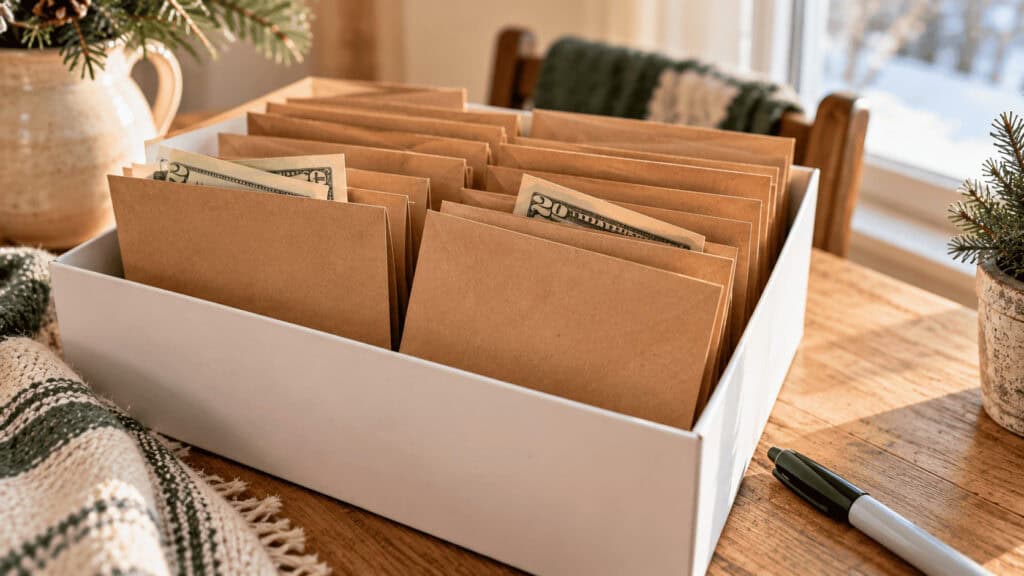
Number 100 envelopes from 1 to 100 and shuffle them in a shoebox. Every time you save, pull an envelope at random and put that many dollars inside. Envelope 7 gets $7. Envelope 82 gets $82. Fill all 100 and you’ll have $5,050.
The random draw is what makes it fun. Some weeks you pull a $3, some weeks you pull a $96 and groan. Pulling two envelopes a week gets you there in about a year.
Be honest with yourself here. $5,050 is about $97 a week. That’s a stretch on one income, which is why the smaller version below exists.
6. The 50 Envelope Savings Challenge
Same idea, half the envelopes. Number them 1 to 50, pull at random, and you’ll save $1,275. One envelope a week finishes it in under a year.
This is the envelope savings challenge I’d hand a beginner. Cheap envelopes from the dollar store and a marker are all you need, and keeping the cash at home in a safe spot makes the progress feel real.
The Monthly Savings Challenge
7. The 12 Month Savings Challenge
If weekly tracking sounds exhausting, save once a month. Put $25 away in January, $50 in February, $75 in March, and keep adding $25 each month until you save $300 in December. That’s $1,950 for the year.
A monthly savings challenge works great if you’re paid once a month, or if your income changes from month to month. You make one transfer when the biggest bills are paid, and you’re done until next month.
Want it flatter? Save $50 every month for $600, or $100 every month for $1,200. Boring? Yes. But boring is what actually gets finished.
One tip: set the transfer for the day after your rent or biggest bill comes out. Money you never see is money you don’t miss.
Mini Savings Challenges for a Quick Win
A whole year is a long time to stay motivated. If you’ve started and quit savings challenges before, try a mini savings challenge first. A short finish line changes everything.
8. The 30 Day Savings Challenge
Save $1 on day 1, $2 on day 2, and so on up to $30 on day 30. In one month you’ll have $465.
The last week asks for $24 to $30 a day, so plan it for a month with three paychecks or a tax refund. Or run it as a 30 day no-takeout challenge and move the money you would’ve spent.
9. Save $1,000 in 3 Months
A starter emergency fund is the most important $1,000 you’ll ever save. Put away $77 a week for 13 weeks and you’ll have $1,001. Paid monthly? That’s about $334 a month.
When something breaks (and on a farm, something always breaks), that $1,000 keeps it off a credit card. If you’re working through debt or a rough stretch, my post on overcoming financial obstacles walks through building that cushion.

Pocket Change Challenges for Tight Budgets
These two are for the months when every dollar already has a job. They feel tiny day to day, and that’s exactly the point.
10. The Penny Challenge (365 Day Savings Challenge)
Save 1 cent on day 1, 2 cents on day 2, and keep going until you save $3.65 on day 365. By New Year’s Eve you’ll have $667.95.
Most days you’re saving less than a cup of gas station coffee. A big jar on the kitchen counter makes it easy for kids to help, too. My tip: cross off the big days (like $3.65 and $3.50) early in the year while your wallet has room, so December stays light.
11. The $5 Bill Challenge
Every time a $5 bill lands in your wallet, it goes straight into a jar. No exceptions. That’s the whole challenge.
How much you save depends on how often you pay cash, so there’s no set total. It pairs really well with a cash budget for groceries. Pay with a $20, get a $5 back in change, and it disappears into the jar before you can spend it on a drive-thru on the way home.
Big Goal Challenges: $5K and $10K
The $10k savings challenge is all over Pinterest, and I love the ambition. But I want to be straight with you about what it takes, because nothing kills motivation like a goal that was never possible on your income.
12. The $5K Savings Challenge
| Pay schedule | Save each time |
|---|---|
| Weekly | $96.15 |
| Every two weeks | $192.31 |
| Monthly | $416.67 |
That’s doable for a lot of two-income households, or a one-income family that puts a tax refund toward it.
13. The $10K Savings Challenge
| Pay schedule | Save each time |
|---|---|
| Weekly | $192.31 |
| Every two weeks | $384.62 |
| Monthly | $833.33 |
If those numbers made your stomach drop, you’re not alone. Here’s how people actually hit $10,000: they stack a smaller challenge with windfalls. A tax refund, a side hustle, selling the stuff in the garage. Run the bi-weekly challenge, add those extras, and you’re a lot closer than you think.
When you’re ready to go even bigger, my $20,000 bi-weekly savings plan breaks it down paycheck by paycheck.
No Spend and Christmas Savings Challenges
14. The No Spend Challenge
This one saves money by not spending it. Pick a stretch of time, cover the true needs (bills, gas, basic groceries), and cut everything else. Whatever you would’ve spent goes straight to savings.
January is the perfect month for it, right after the holiday spending. We once did a spending freeze where we lived on about $100 a month for six months, and it completely reset how I think about money. You can read how we did our spending freeze, or start smaller with my no spend February guide.
15. The Christmas Savings Challenge
The best time to start saving for next Christmas is right now, in January. Aim for $1,000 by December:
- Weekly: $19.23
- Every two weeks: $38.46
- Monthly: $83.33
No more holiday credit card bills in January. Track it alongside my printable Christmas planner so you know who’s on the list before the money’s even saved.
The same math works for any sinking fund. A car savings challenge, a vacation fund, a new roof. Divide the goal by your paychecks and start. Here’s how to budget and save for a car if that’s your next big one.

Where to Find the Money on a Low Income
“Great, but where does the money come from?” I hear you. When there’s nothing left at the end of the month, a savings challenge has to be funded by cutting something. These are the places I look first:
- Groceries. This is the biggest flexible line in most budgets. Meal plan, shop your pantry first, and cook from scratch. My grocery budget tips show exactly how I keep our bill down.
- Subscriptions and cable. Cancel one streaming service and move that $10 to $20 straight into your challenge. Here are the cheapest alternatives to cable TV.
- Buy ahead, not in a panic. A small stockpile bought on sale keeps you out of the store at full price. Start with stockpiling without extreme couponing.
- Sell what you don’t use. January is a great time to clean out closets and the garage and list it. Every dollar from a sale goes in the jar.
- Use windfalls on purpose. Tax refunds, birthday cash, a little overtime. Decide now that half goes to your challenge.
One small swap is all you need to fund the smaller challenges in this post. Fifty cents a week is a lot easier to find than you’d think.
How to Stick With Your Savings Challenge (Free Printables)
Starting is easy. The middle of the challenge is where most of us quit. Here’s what keeps me going:
- Open a separate savings account. If the money sits in checking, it gets spent. Out of sight really is out of mind.
- Automate it. Set the transfer for payday so you never have to decide.
- Track it on paper. Coloring in a box on a printed chart is weirdly satisfying, and seeing the progress keeps you motivated.
- Miss a week? Don’t quit. Just pick up where you left off. A half-finished challenge still beats zero savings.
- Celebrate milestones. Hit $100? Have a movie night at home. Small rewards go a long way.
For more, here are my strategies to stay motivated during a savings challenge.
Free savings challenge printables: Grab the free trackers in my bi-weekly savings challenge guide, including a 100 day savings challenge chart ($5 to $25 a day), a $5 paycheck tracker, and a blank weekly savings tracker you can use with any challenge in this post.
If you want your challenge, bills and spending all in one spot, I use my Ultimate Budget Planner every month. It’s simple, and I can reuse it all year.
You don’t need a high income to start saving. You need a plan small enough to finish. Pick one savings challenge from this list, print your tracker, and make your first save this week. Fifty cents counts.
Which challenge are you starting this year? Tell me in the comments. I love cheering you on.
Free up money for your savings challenge. Groceries are the easiest place to find extra cash every week. Grab my Meal Planner and plan cheap, from-scratch meals that leave room in the budget to save.

 A Farmhouse Christmas Porch Doesn’t Need a Big Budget
Leave a Reply